Interactive tool · Preview
Drybench Sequence.
Translate sequences, find open reading frames, inspect protein properties and check primers. Explore the methods and published reference checks behind the tools.
Example data: Human preproinsulin (P01308). UniProtKB P01308 and RefSeq NM_000207.3, The UniProt Consortium (CC BY 4.0) and NCBI (public domain)
- Free to use
- Runs in your browser
- Transparent methods
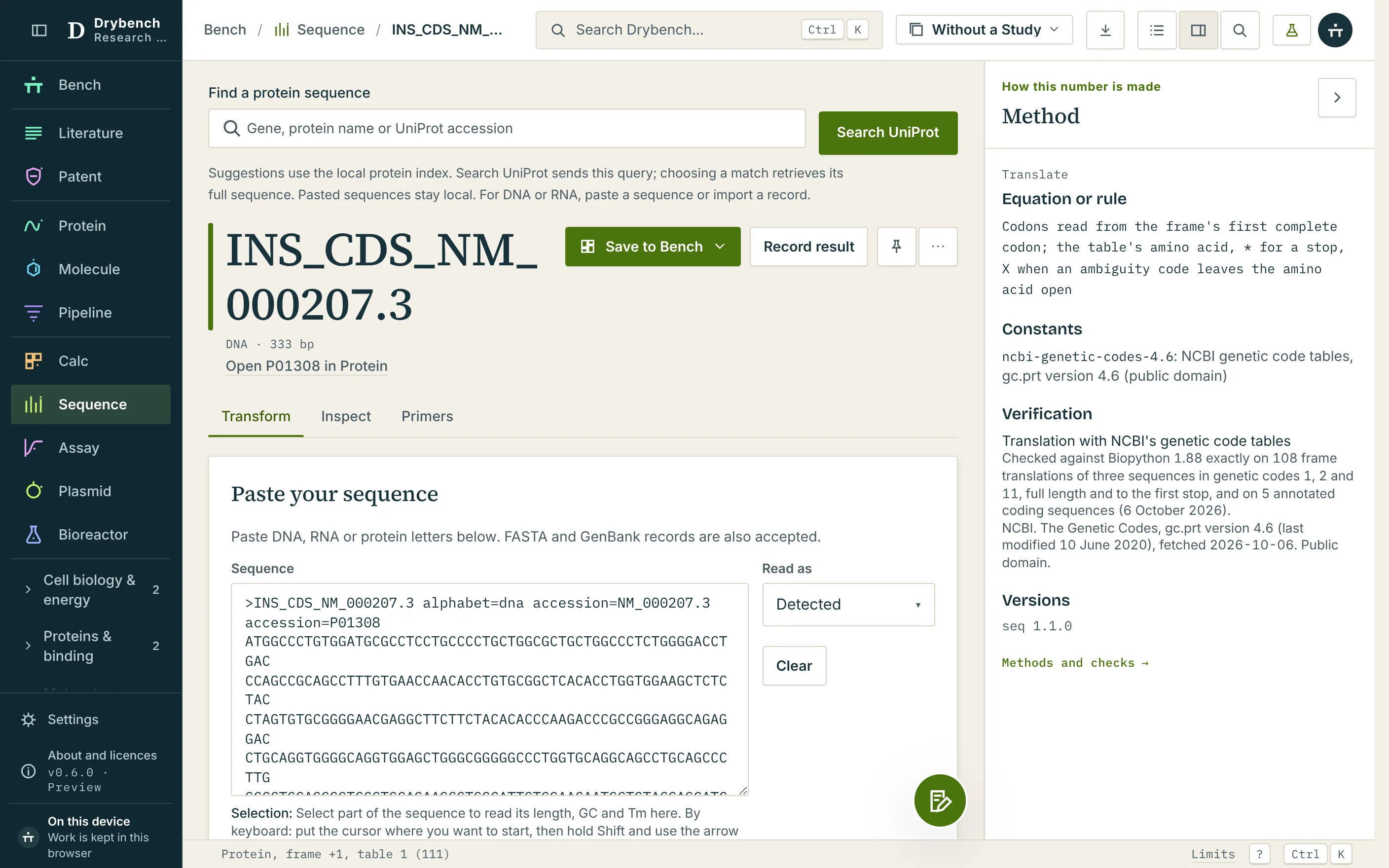
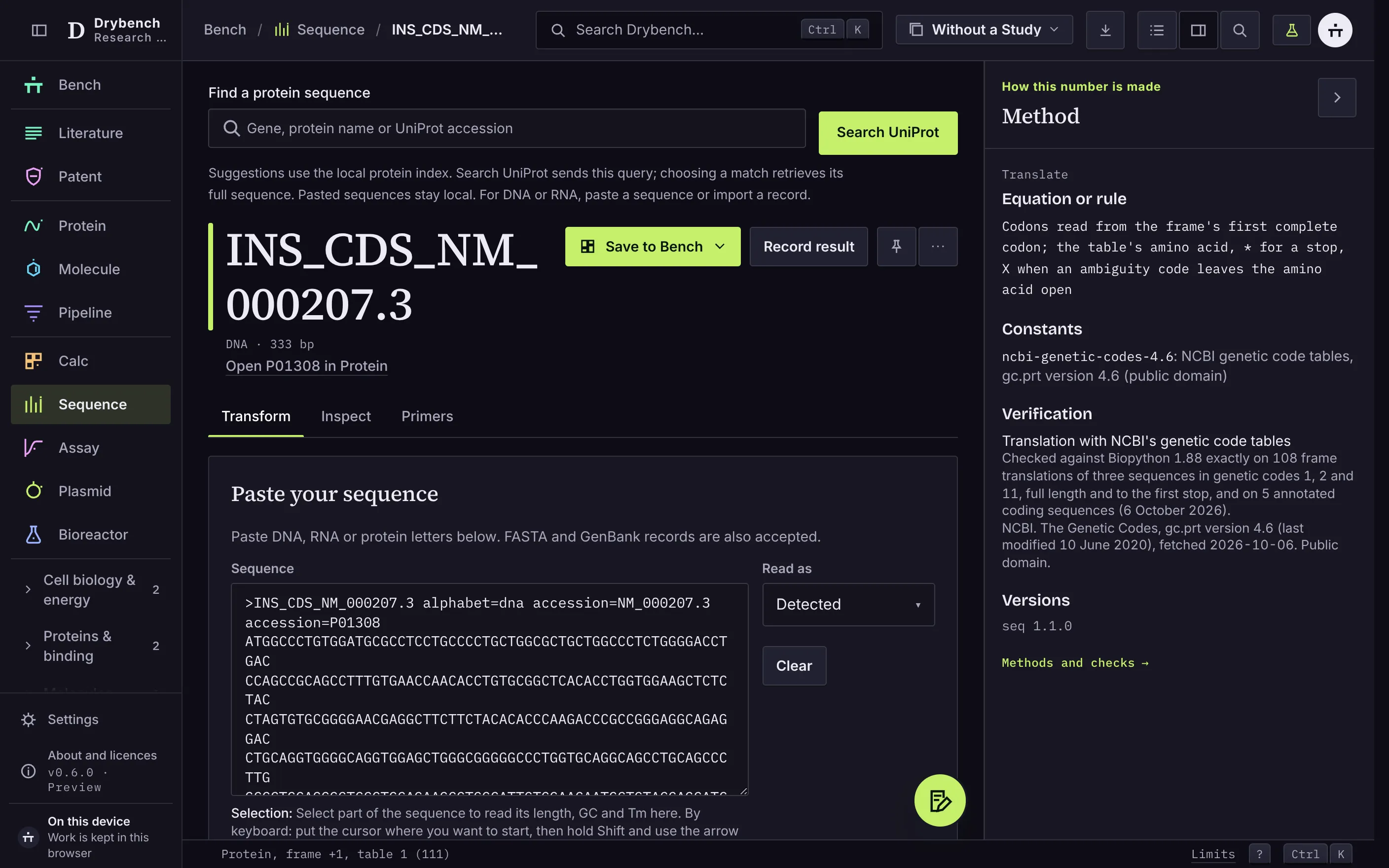
Illustration · Explore the real workspace below
See the tools at work.
scan worker about 20 KB, for inputs over 100 kb
What you can do with it
Paste once
Raw letters, a FASTA record, several records or a GenBank file: the alphabet is detected and shown, the record's name and accession are read, and every operation computes on the same paste.
Translate with any code
One frame or all six, with any of NCBI's genetic codes, stops marked, alternative initiation codons off unless you turn them on, and the table id carried with the answer.
ORFs as ORFfinder counts
ATG to stop, 75 nt or longer, nested ORFs hidden, ORFs without a stop listed apart; each rule is on the card and can be changed.
Construct-aware numbers
His6, FLAG, HA, Myc, Strep, V5, S, Avi and T7 tags and the TEV, thrombin, Factor Xa, PreScission and enterokinase sites are found by their motifs, and MW, pI and ε280 are given as expressed and after the cut you confirm.
Oligo Tm, the model named
SantaLucia 1998 nearest-neighbour thermodynamics with the Owczarzy 2004 sodium correction, or the 2008 magnesium correction when Mg²⁺ is present, under both the primer-in-excess and equal-strands models, since the choice moves the answer by two to three degrees.
Primer checks, not design
The pair's ΔTm, an annealing temperature labelled as the rule of thumb it is, hairpins, self-dimers and the cross-dimer by the SantaLucia and Hicks 2004 rules, and the sites where each primer binds a template with the product length.
Inspect the reference checks
Published verification sets name their reference tools, versions, inputs, expected outputs and comparison tolerances.
Same numbers next year
Method versions are pinned and travel with every result; the versioned example links (insulin@1 and the others) are made for teaching.
Start with a worked example
Explore a configured workflow with its starting data and methods ready to inspect.
- Reference inputs
DNA Six Frame Translation and ORF Sequence Inspector
Explore interactive six-frame translation in your browser, pre-loaded with a cited lac-operon reference. Inspect ORFs, genetic code, strand and GC assumptions.
Starting data: E. coli lac operon J01636.1, bases 1–1500
Explore example - Reference inputs
PCR Primer Pair Tm and Template Annealing Inspection
Inspect interactive primer melting temperatures in your browser, pre-loaded with a cited template pair. Review nearest-neighbour assumptions and exact matches.
Starting data: Reference primer pair on J01636.1 bases 1–600
Explore example
See the evidence behind the answer.
Explore the methods and sources behind the tools.
Read the methodsWhere every panel's data comes from
NCBI genetic code tables
NCBI genetic code tablesPublic domain (NCBI)The 27 translation tables (gc.prt version 4.6) parsed into the app at build time: codons, amino acids and initiation codons.
NCBI Taxonomy. The Genetic Codes, gc.prt version 4.6, last modified 10 June 2020; fetched 6 October 2026.
ExPASy ProtParam residue masses and pK values
ExPASy ProtParam residue masses and pK valuesValues cited from the documentationThe average residue masses and the Bjellqvist pK values the protein app has always used, kept as the default so the two apps give one number; a CIAAW-derived residue table sits behind a second id.
Gasteiger E, Hoogland C, Gattiker A, et al. Protein identification and analysis tools on the ExPASy server. In: The Proteomics Protocols Handbook. Humana Press; 2005:571-607. Documentation read 5 October 2026. ProtParam is a tool of the SIB Swiss Institute of Bioinformatics; not affiliated.
Bjellqvist et al. 1993 and 1994, isoelectric point
Bjellqvist et al. 1993 and 1994, isoelectric pointMethod (cited)The pK values of the charged residues and the termini, with bisection on the net charge over pH 0 to 14.
Bjellqvist B, Hughes GJ, Pasquali C, et al. Electrophoresis 1993;14:1023-1031; Bjellqvist B, Basse B, Olsen E, Celis JE. Electrophoresis 1994;15:529-539.
Pace et al. 1995, molar absorption coefficients
Pace et al. 1995, molar absorption coefficientsMethod (cited)ε280 = 5,500 per Trp + 1,490 per Tyr + 125 per cystine, in both conventions (all cysteines paired, all reduced).
Pace CN, Vajdos F, Fee L, Grimsley G, Gray T. How to measure and predict the molar absorption coefficient of a protein. Protein Sci 1995;4:2411-2423.
SantaLucia 1998, unified nearest-neighbour parameters
SantaLucia 1998, unified nearest-neighbour parametersValues cited from the published tableΔH° and ΔS° of the ten Watson-Crick stacks, the initiation, terminal A·T and symmetry terms, for oligo Tm and for the stacks of hairpins and dimers.
SantaLucia J Jr. A unified view of polymer, dumbbell, and oligonucleotide DNA nearest-neighbor thermodynamics. Proc Natl Acad Sci USA 1998;95:1460-1465. Table 2 read 6 October 2026.
Owczarzy et al. 2004, sodium correction
Owczarzy et al. 2004, sodium correctionMethod (cited)The monovalent salt correction of 1/Tm (equation 22), the default without Mg²⁺.
Owczarzy R, You Y, Moreira BG, et al. Effects of sodium ions on DNA duplex oligomers: improved predictions of melting temperatures. Biochemistry 2004;43:3537-3554.
Owczarzy et al. 2008, magnesium correction
Owczarzy et al. 2008, magnesium correctionMethod (cited)The Mg²⁺ and mixed-cation correction (equations 16 and 18 to 20), with the regime chosen by R = √[Mg²⁺]/[Mon⁺] exactly as published and free Mg²⁺ after dNTP binding.
Owczarzy R, Moreira BG, You Y, Behlke MA, Walder JA. Predicting stability of DNA duplexes in solutions containing magnesium and monovalent cations. Biochemistry 2008;47:5336-5353.
SantaLucia and Hicks 2004, DNA structural motifs
SantaLucia and Hicks 2004, DNA structural motifsValues cited from the published tablesLoop initiation by length, the internal mismatch increments, the initiation and terminal A·T terms and the rules for hairpins, bulges, internal loops and dangling ends, for hairpin and dimer ΔG at 37 °C.
SantaLucia J Jr, Hicks D. The thermodynamics of DNA structural motifs. Annu Rev Biophys Biomol Struct 2004;33:415-440. Tables 1 to 4 read 6 October 2026.
Bommarito, Peyret and SantaLucia 2000, dangling ends
Bommarito, Peyret and SantaLucia 2000, dangling endsValues cited from the published tableΔH° and ΔG°37 of the 32 single-nucleotide dangling ends, for helix ends and terminal mismatches in hairpins and dimers.
Bommarito S, Peyret N, SantaLucia J Jr. Thermodynamic parameters for DNA sequences with dangling ends. Nucleic Acids Res 2000;28:1929-1934, as SantaLucia and Hicks 2004 Table 3 reprints it; read 6 October 2026.
Nearest Neighbor Database (NNDB), DNA terminal mismatches
Nearest Neighbor Database (NNDB), DNA terminal mismatchesValues cited from the public table; licence to be checkedThe ΔG°37 increments of the first mismatch in a hairpin loop, which SantaLucia and Hicks 2004 attribute to Varma and SantaLucia (unpublished); the database is their only public source, and only this table is read from it.
Turner DH, Mathews DH. NNDB: the nearest neighbor parameter database for predicting stability of nucleic acid secondary structure. Nucleic Acids Res 2010;38:D280-D282; Mittal A, Turner DH, Mathews DH. Nucleic Acids Res 2024. Table read and saved 6 October 2026.
IUPAC CIAAW standard atomic weights 2021
IUPAC CIAAW standard atomic weights 2021Values cited from the published tableThe molecular weight of a DNA or RNA strand from its residue formulas, the conventional value for each interval element, as exact decimals held in one table under src/lib.
Prohaska T, Irrgeher J, Benefield J, et al. Standard atomic weights of the elements 2021 (IUPAC Technical Report). Pure Appl Chem 2022;94:573-600. ciaaw.org read 6 October 2026.
UniProtKB (UniProt REST API)
UniProtKB (UniProt REST API)CC BY 4.0Explicit protein search and full canonical sequence lookup, retaining accession, organism, release and retrieval date
The UniProt Consortium. UniProt: the Universal Protein Knowledgebase in 2025. Nucleic Acids Res 2025;53:D609-D617.
Where it runs and what it sends
Public data hosts declared for this app: rest.uniprot.org.
Anything in the address bar before the # (a search, a SMILES, an accession or a step) is sent to this site's host when a page loads or a link is opened; anything after the # is not sent.
Not used, by licence:
- Primer3 (ntthal, oligotm). GPL-2: run offline as the oracle for hairpin and dimer ΔG and never shipped, and its parameter files are never copied.
- Sequence Manipulation Suite (SMS2). GPL-3: a behaviour reference for reverse complement and translation only; no code is ported.
- EMBOSS. GPL applications: a behaviour reference only; no code is ported.
- CRISPOR. Academic-only licence; commercial use, including running the tool, needs a UCSC licence, so it is not run even as an oracle.
- REBASE and NEB enzyme data. Restriction digests are the plasmid app's job and are not in this version; their terms are unverified.
- IDT, NEB and Thermo Tm calculators. Vendor terms; comparisons only, and the conditions you type here approximate a buffer, not a vendor's calculator.
- Kazusa and CoCoPUTs codon usage tables. Terms not stated; codon usage is not in this version.
- Biopython tables. Not copied: the values come from the cited papers; Biopython is an offline test oracle only.
- Benchling. Never used; a sequence editor is a different design.
Built for research and education. The tools have not been validated for regulated use. Read the regulatory position
Make your next step a practical one.
Open the app and explore the example.