Interactive tool · Preview
Drybench Bioreactor.
Explore batch, fed-batch and chemostat behaviour with a teaching simulation. Change the feed and oxygen-transfer settings, then inspect the model’s assumptions, cited or illustrative parameters and limits.
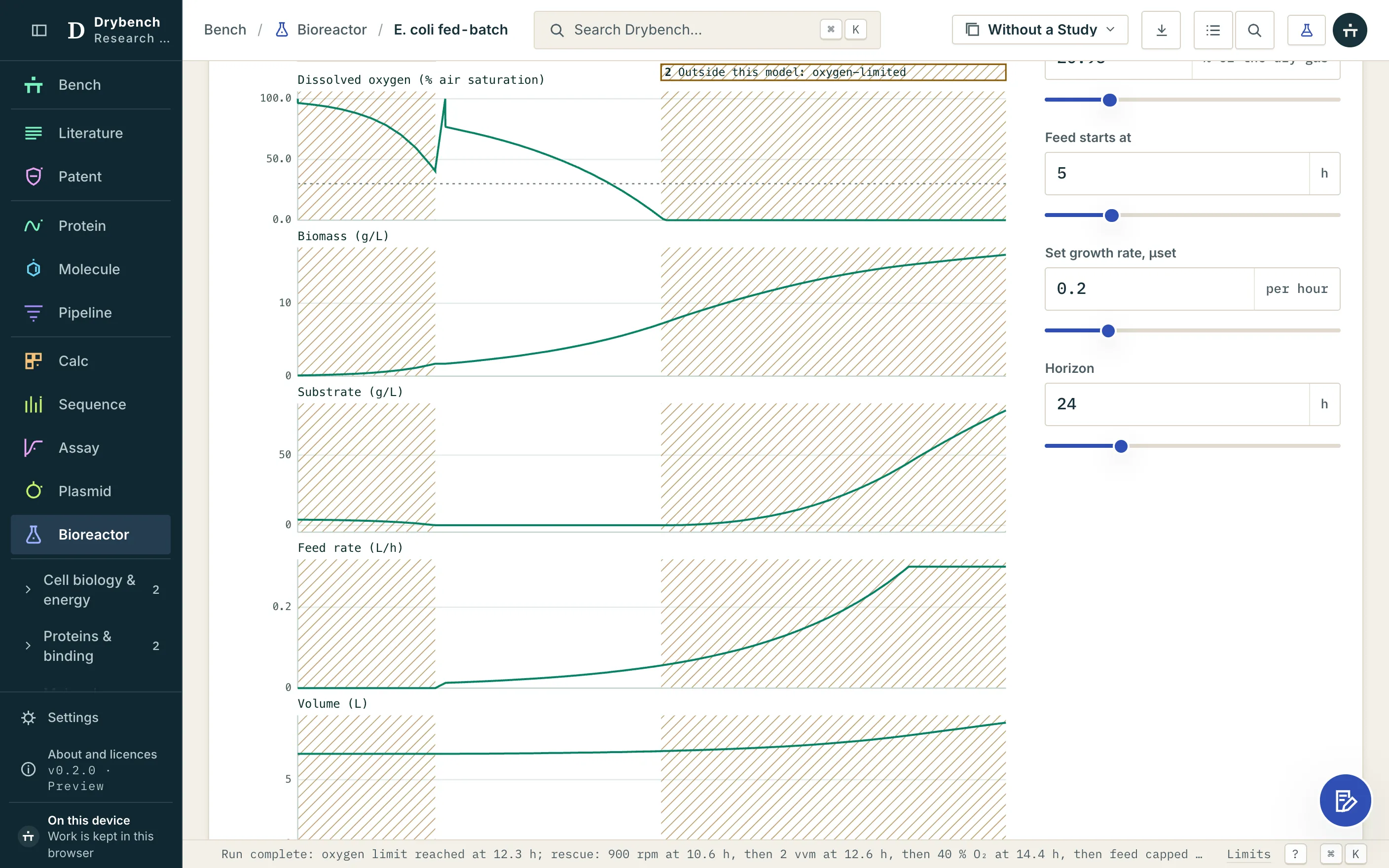
Example data: The E. coli fed-batch preset: oxygen runs out in a 10 L vessel, and the rescue. Values from Haverkorn van Rijsewijk et al. 2011, Kovárová-Kovar and Egli 1998, Nanchen et al. 2006, Stolper et al. 2010, Folsom and Carlson 2015 and Vemuri et al. 2006, each shown with its table
- Free to use
- Runs in your browser
- Transparent methods
Illustration · Explore the real workspace below
See the tools at work.
What you can do with it
When oxygen runs out
The time the culture would take up more oxygen than the simulated vessel can transfer, from its own oxygen balance with C* from the exhaust gas, with the lowest dissolved oxygen, biomass and peak uptake beside it.
A rescue within your limits
Raise the agitation, then the gas flow, then the inlet's oxygen, each within the limits you enter, and last cap the feed: the smallest step on each lever's grid that holds the setpoint, said as text, with cooling capacity ignored and said so.
Your vessel and kLa
Enter a measured kLa, or your readings at several rpm, or compute kLa from Van 't Riet's correlation with Hughmark's gassed power, its range stated and anything outside it marked extrapolated.
Presets you can check
Each value with its paper, table and reported range, or labelled illustrative where no read source gives it, and every published preset version held to its golden run so a teaching link gives the same run next year.
Where the model stops
Numbered notes mark where a run leaves the biology the model covers, such as E. coli's acetate at fast glucose uptake or oxygen-limited growth, on the chart, the table, the tiles and every export.
Pump and bench sheet
The rate to set for each interval of the feed, as its average over the interval so the volumes add up, printed on A4 with the setup, the rescue, the chart and the method block.
Compare and teach
Two runs on one chart from one link, and a lecturer mode that shows nothing of the run until a prediction is entered.
Checked against SciPy
The engine agrees with SciPy's Radau on 33 published scenarios at stated tolerances, with the closed forms, the oxygen solubility and the mass balances checked; the fixtures and their hashes are on the verification page.
Start with a worked example
Explore a configured workflow with its starting data and methods ready to inspect.
- Reference inputs
Monod Fed Batch Growth and Substrate Model Simulator
Explore an interactive E. coli fed-batch simulation in your browser. Inspect Monod growth, feed, substrate and oxygen balances with cited parameter assumptions.
Starting data: Versioned E. coli composite fed-batch preset
Explore example - Reference inputs
kLa Oxygen Transfer and Uptake Balance Model Explorer
Explore oxygen transfer and uptake in an interactive bioreactor model. Inspect kLa, dissolved oxygen, gas assumptions and correlation limits in your browser.
Starting data: E. coli preset with correlation-derived kLa
Explore example
See the evidence behind the answer.
Explore the methods and sources behind the tools.
Read the methodsWhere every panel's data comes from
Monod 1949; Andrews 1968 (growth and substrate inhibition)
Monod 1949; Andrews 1968 (growth and substrate inhibition)Method (cited)μ = μmax·S/(Ks + S), and S/(Ks + S + S²/Ki) for methanol; here acting on uptake, so the factor (μmax + 2Y·ms)/μmax is stated beside each preset.
Monod J. The growth of bacterial cultures. Annu Rev Microbiol 1949;3:371-394. Andrews JF. A mathematical model for the continuous culture of microorganisms utilizing inhibitory substrates. Biotechnol Bioeng 1968;10:707-723, doi:10.1002/bit.260100602 (read 5 October 2026).
Pirt 1965; Luedeking and Piret 1959 (maintenance and product)
Pirt 1965; Luedeking and Piret 1959 (maintenance and product)Method (cited)qS = μ/Y + ms while cells grow; qP = α·μ + β, drawing on the same substrate budget as growth.
Pirt SJ. Proc R Soc B 1965;163:224-231. Luedeking R, Piret EL. J Biochem Microbiol Technol Eng 1959;1:393-412 (read 5 October 2026).
Shampine and Reichelt 1997 (the solver)
Shampine and Reichelt 1997 (the solver)Method (cited)The modified Rosenbrock (W-) formula of §3.1 with its continuous extension, implemented from the paper only; no MATLAB or Octave code read.
Shampine LF, Reichelt MW. The MATLAB ODE Suite. SIAM J Sci Comput 1997;18(1):1-22 (read 6 October 2026).
Benson and Krause, as documented by the USGS (oxygen's solubility)
Benson and Krause, as documented by the USGS (oxygen's solubility)Method (cited); a US government work in the public domainAir saturation at 0 to 40 °C and 0.5 to 1.1 atm, with the water-vapour and non-ideal terms; checked against the USGS DOTABLES program's own output.
USGS Office of Water Quality Technical Memorandum 2011.03, attachment eqs. 7 and 9 to 11 (read 6 October 2026).
Van 't Riet 1979; Hughmark 1980; Yawalkar et al. 2002 (kLa and gassed power)
Van 't Riet 1979; Hughmark 1980; Yawalkar et al. 2002 (kLa and gassed power)Method (cited)kLa = a·(Pg/V)^b·vs^c with the coalescing constants as Yawalkar et al. quote them (Table 2), and Hughmark's gassed power with its range (Table 3); non-coalescing 0.002(Pg/V)^0.7·vs^0.2 and the approximate experimental ranges are cited to Van 't Riet 1979, not yet read against a clean copy, and marked Unverified. Np=5 is nominal for standard baffled turbulent Rushton geometry, with additive multi-impeller power requiring calibration.
Van 't Riet K. Ind Eng Chem Process Des Dev 1979;18:357-364, doi:10.1021/i260071a001. Yawalkar AA, Heesink ABM, Versteeg GF, Pangarkar VG. Gas-liquid mass transfer coefficient in stirred tank reactors. Can J Chem Eng 2002;80:840-848, doi:10.1002/cjce.5450800507 (read 6 October 2026). Kaiser SC, Werner S, Jossen V, Kraume M, Eibl D. Eng Life Sci 2017;17(5):500-511, doi:10.1002/elsc.201600096 (PMC5434943; read in full 24 October 2026): §3.3.1 and Table 3 compile Rushton Np of 3.6 to 5.9 for fully turbulent turbines in four-baffled flat-bottomed vessels, and §3.3.1 with Fig. 6 measures 4.17 ± 0.14 at Re above 10⁴ (three baffles, torospherical base); Np=5 stays a nominal default.
The presets' values (cited papers)
The presets' values (cited papers)Values (cited from the papers)Growth, uptake, yield, maintenance, oxygen affinity, composition and the onsets the flags use, each with its paper, table, DOI and reported range on its preset's page and in Setup; values with no measured source are labelled illustrative, and values from memory unverified.
Eighteen papers, each read on 6 October 2026 (full text or abstract, as each value's source says).
The oracle fixtures and the golden runs
The oracle fixtures and the golden runsMIT (generated; no third-party data)The scenarios, closed forms, transfer and scale-up cases and right-hand sides the engine is checked against, and each preset version's golden runs.
pipeline/bioreactor-simulator/reference.py and write-golden.mts (the suite's authors, 6 October 2026).
Where it runs and what it sends
This app declares no external public data hosts.
Anything in the address bar before the # (a search, a SMILES, an accession or a step) is sent to this site's host when a page loads or a link is opened; anything after the # is not sent.
Not used, by licence:
- bioprocesstools.com code and content. Its terms make the tools the site's property with no republishing or redistribution, so nothing of it is used; its behaviour is a qualitative reference only.
- bioreactor-sim. No licence is stated, so all rights are reserved and nothing of it is used.
- Textbook figures and parameter tables. A compilation's copyright attaches to the figure or table, so each value is cited to its primary paper instead and no figure is reproduced.
- Vendor documentation for vessels and impellers. Vendor manuals are their makers' copyright and describe specific products; the vessel's limits and kLa are yours to enter.
- FedBatchDesigner. MIT-licensed, but kept as a reference by policy: nothing of its code is used.
- simulations4all. Its terms are unknown, so nothing of it is used.
Built for research and education. The tools have not been validated for regulated use. Read the regulatory position
Make your next step a practical one.
Open the app and explore the example.