Interactive tool · Preview
Drybench Plasmid.
Open a plasmid sequence to inspect its annotated map, restriction sites and sequencing-primer sites. Compare candidate diagnostic digests with a schematic gel and review the evidence behind each matched feature.
Example data: pUC19 (GenBank L09137.2), a classic cloning vector. GenBank L09137.2, Cloning vector pUC19c (NCBI; no restrictions, depositor terms may apply)
- Free to use
- Runs in your browser
- Transparent methods
Illustration · Explore the real workspace below
See the tools at work.
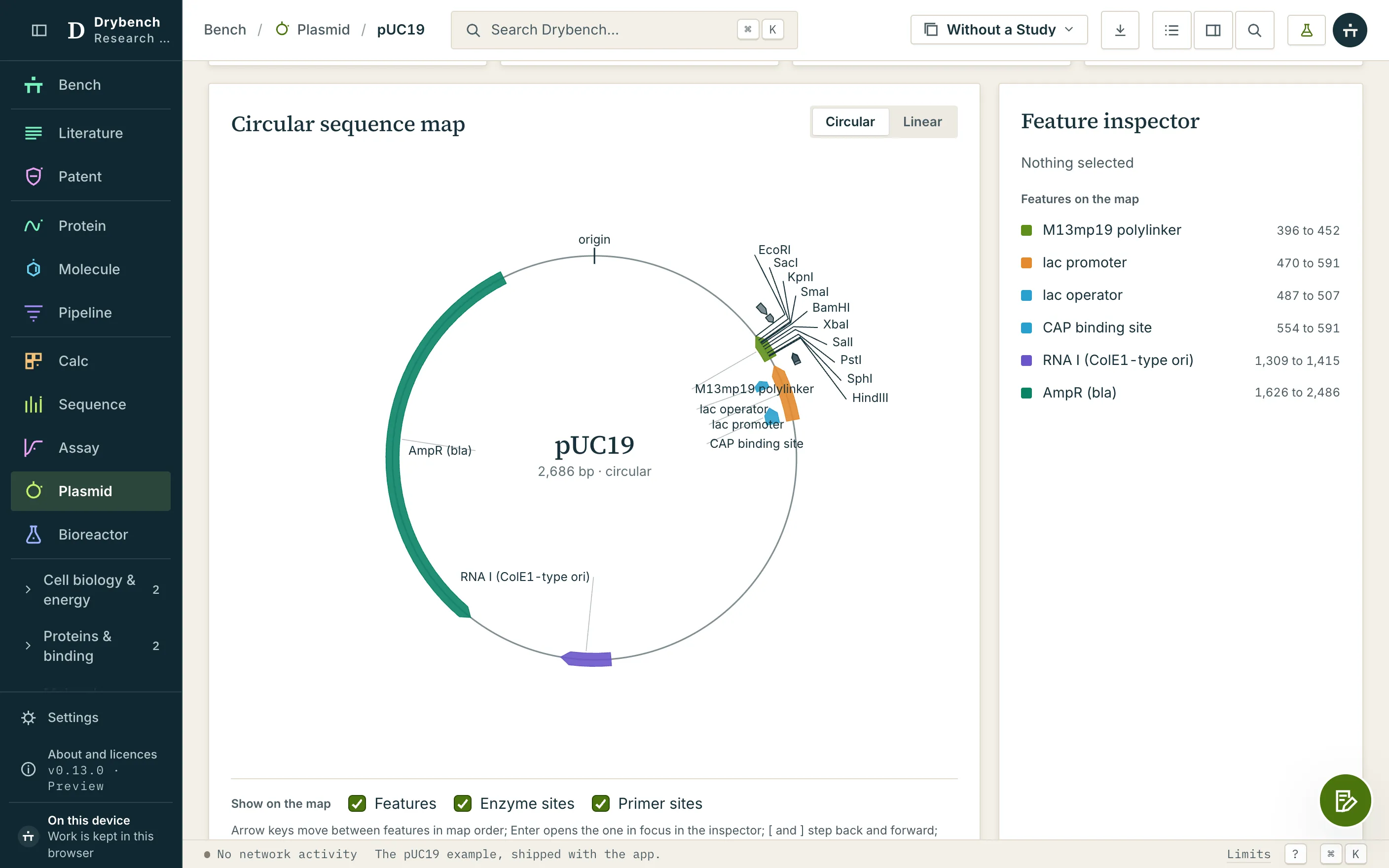
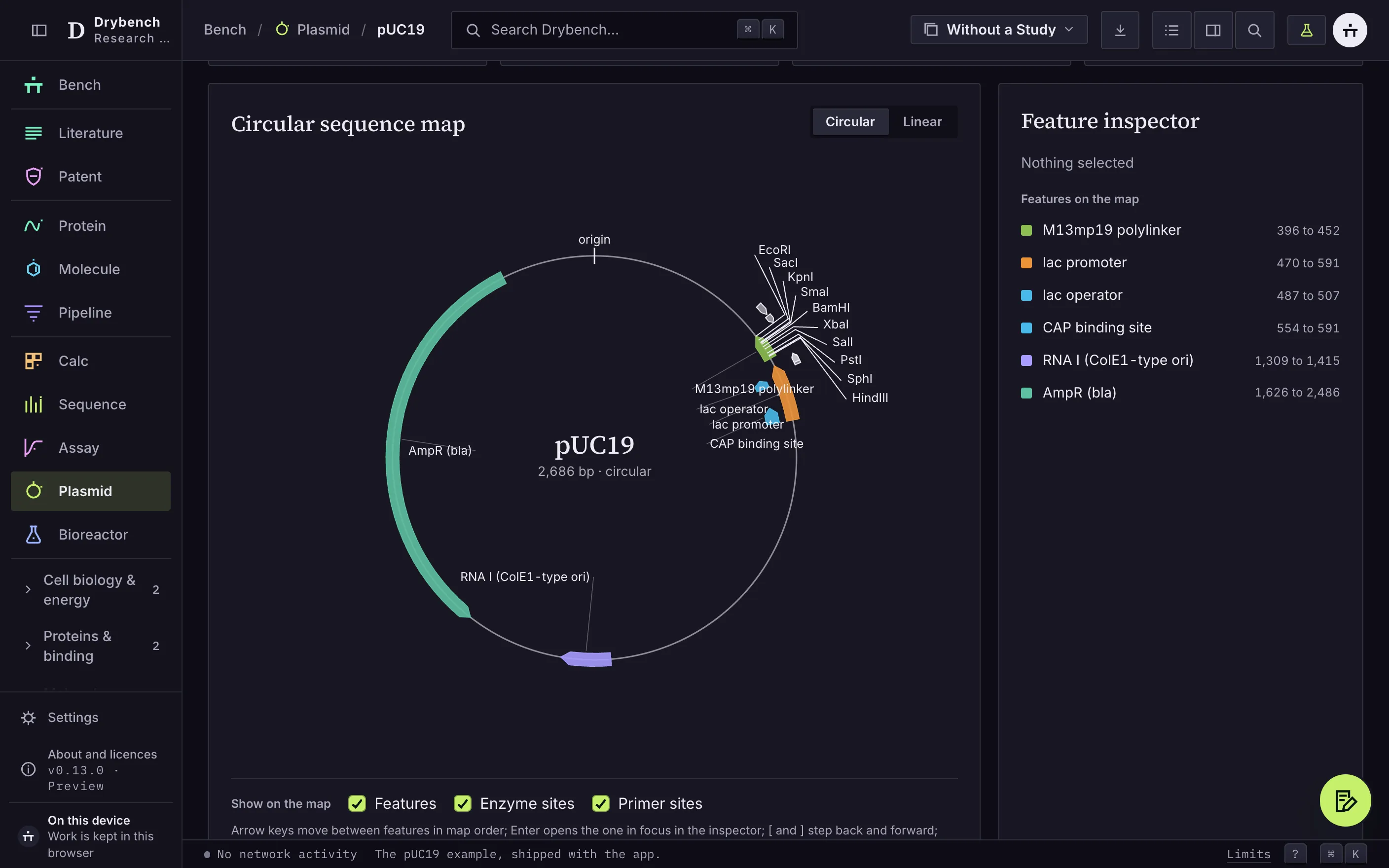
The annotation library (about 110 KB), the enzyme table (about 80 KB) and the primer set (about 4 KB) load from this site once a sequence is open; the worker computes in your browser.
What you can do with it
Digests that prove a clone
Mark the insert and the picker compares this plasmid with the insert removed and with it reversed, then lists the single and double digests whose schematic gels tell all three apart, with the bands that differ written out.
Evidence with its numbers
Every feature the library finds carries its identity, coverage, mismatches and gaps; a partial match says whether it is truncated or mutated, and the word never appears without its numbers.
Methylation as you set it
Sites a dam or dcm mark blocks are struck through with the reason from McClelland et al. 1994, Table I; a site whose sensitivity is not recorded reads "may be blocked" and is never counted as a cut.
Numbers for this plasmid
The double-stranded weight from the plasmid's own sequence, with ng to pmol, copies per µL for qPCR standards and ligation insert amounts beside the 650 Da per bp rule it replaces.
Sequencing-primer sites
Universal primers named as their makers' manuals name them, found exactly or with one mismatch, with the mismatch's place counted from the 3′ end and no claim about whether it primes.
Read-only .dna files
SnapGene .dna files open read-only, by a reader written from the public packet structure; a file with a block the reader does not know is refused, with the reason, rather than half read.
Maps as links for small plasmids
A plasmid up to about 5,500 bp travels in a link, packed two bits a base after the #; a larger one, or one with your own feature edits, travels as a GenBank file.
Checked in the open
Enzyme rows checked against Biopython 1.88 Bio.Restriction on pUC19 and pBR322, and feature calls against its PairwiseAligner on 26 alignments within 0.1 percentage points (2026-10-06); the fixtures are published on the verification page.
Start with a worked example
Explore a configured workflow with its starting data and methods ready to inspect.
- Reference inputs
GenBank and FASTA Plasmid Map Viewer with Annotations
Explore an interactive plasmid map in your browser, pre-loaded with a cited pUC19 reference. Inspect sequence features, restriction sites and annotation limits.
Starting data: pUC19, GenBank L09137.2
Explore example - Reference inputs
Virtual Restriction Digest and Gel Fragment Simulator
Inspect an interactive double digest in your browser, pre-loaded with a pUC19 reference. Compare fragment sizes, enzyme sites, topology and schematic gel bands.
Starting data: pUC19 EcoRI/HindIII double digest
Explore example - Synthetic example
Golden Gate Type IIS Overhang and Assembly Inspector
Inspect interactive Golden Gate assembly in your browser, pre-loaded with a BsaI reference cassette. Check overhangs, sequence joins and internal-site limits.
Starting data: BsaI-flanked EGFP part and synthetic destination
Explore example - Reference inputs
CRISPR SpCas9 NGG PAM and Guide Sequence Inspection Tool
Inspect interactive SpCas9 sites in your browser, pre-loaded with a pUC19 reference window. Explore NGG PAMs and strands; no off-target or Cas12a score is made.
Starting data: pUC19 bases 1–80, linear inspection window
Explore example
See the evidence behind the answer.
Explore the methods and sources behind the tools.
Read the methodsWhere every panel's data comes from
NCBI GenBank nucleotide records
NCBI GenBank nucleotide recordsNo NCBI restrictions; depositor terms may applyThe annotation library's 90 parts, each cut from a feature its record's submitters annotated, with the accession, location and retrieval date; the pUC19 (L09137.2) and pBR322 (J01749.1) examples; the primers' binding-site checks; and the record you fetch by accession when you ask.
Records cited by accession and version; NCBI policies read 5 October 2026.
UniProt
UniProtCC BY 4.0The protein entries UniProt cross-references to the library's protein-coding parts, so a CDS opens in the protein app by accession.
The UniProt Consortium. UniProt: the Universal Protein Knowledgebase in 2025. Nucleic Acids Res 2025;53:D609-D617.
McClelland, Nelson and Raschke 1994 (dam and dcm sensitivity)
McClelland, Nelson and Raschke 1994 (dam and dcm sensitivity)Data (cited)Each enzyme's entries for N6-methyladenine (dam, GATC) and 5-methylcytosine (dcm, CCWGG) at each base and strand, with the page of Table I; an enzyme or base with no entry reads "may be blocked".
McClelland M, Nelson M, Raschke E. Effect of site-specific modification on restriction endonucleases and DNA modification methyltransferases. Nucleic Acids Res 1994;22(17):3640-3659, Table I (read 6 October 2026).
The enzyme table (recognition sites and cuts as published facts)
The enzyme table (recognition sites and cuts as published facts)Our own content223 commercially available enzymes in common use, typed by hand, each with its recognition site, its cut on each strand and a link to the enzyme's public page; isoschizomers kept where the cut or the methylation sensitivity differs.
Enzyme table version 1, built 2026-10-06.
Smith and Waterman 1981; Gotoh 1982 (local alignment with affine gaps)
Smith and Waterman 1981; Gotoh 1982 (local alignment with affine gaps)Method (cited)The local alignment behind every feature call, with the scoring stated on the methods page.
Smith TF, Waterman MS. Identification of common molecular subsequences. J Mol Biol 1981;147:195-197. Gotoh O. An improved algorithm for matching biological sequences. J Mol Biol 1982;162:705-708.
Vector makers' manuals (sequencing primer names)
Vector makers' manuals (sequencing primer names)Data (cited)The name of each shipped primer, exactly as its maker's manual gives it: Thermo Fisher Scientific's TOPO TA Cloning Kit (MAN0000047), pcDNA3.1 (version K) and pcDNA3.4-TOPO TA (MAN0007209) user guides, and Promega's pGEM-T and pGEM-T Easy Vector Systems manual (TM042); no text copied.
Read 6 October 2026. Each primer is also found exactly at a binding site in an NCBI record.
Geier and Modrich 1979 (DpnI)
Geier and Modrich 1979 (DpnI)Method (cited)DpnI's blunt cut, GA^TC, 3′ of the methylated adenine, beside McClelland 1994's entry that it cuts only GATC methylated on both strands.
Geier GE, Modrich P. Recognition sequence of the dam methylase of Escherichia coli K12 and mode of cleavage of Dpn I endonuclease. J Biol Chem 1979;254(4):1408-1413 (abstract read 6 October 2026).
DNA ladder product sheets (band sizes)
DNA ladder product sheets (band sizes)Data (cited); use to be checkedEach ladder's band sizes, typed by hand from its supplier's product sheet; drawn as listed, never used to size or match a band.
Sheets MAN0013004 and MAN0013047, Rev. D.00, read 17 October 2026.
The plasmid map's fixtures
The plasmid map's fixturesMITThe oracle values the engine is checked against, the synthetic .dna files and the hand-worked methylation cases, written by the pipeline's scripts.
pipeline/plasmid-map/reference.py and make-dna-fixtures.py (the suite's authors, 6 October 2026).
Where it runs and what it sends
Public data hosts declared for this app: eutils.ncbi.nlm.nih.gov.
Anything in the address bar before the # (a search, a SMILES, an accession or a step) is sent to this site's host when a page loads or a link is opened; anything after the # is not sent.
Not used, by licence:
- Addgene maps, annotations, sequences and primer table. Addgene's terms allow noncommercial use only and grant no reuse licence.
- FPbase. CC BY-SA 4.0 would make the library file a share-alike adaptation; fluorescent proteins are taken from their GenBank and UniProt records instead (shipping FPbase as a separate share-alike file is the CEO's decision).
- The iGEM Registry. Terms not read; parts are re-sourced from GenBank where needed.
- SnapGene's feature database and SnapGene-annotated records. Proprietary; the library takes only features that records' own submitters annotated.
- GPL plasmid-annotation tools and their feature databases. GPL-3.0 code, and databases derived from SnapGene's; none is run, shipped or used for fixtures.
- Bulk restriction-enzyme data downloads. Their terms are unconfirmed, so the table is typed by hand from published facts and only checked against an offline oracle.
- NEB data (NEBcutter outputs and NEB tables). Not reusable; NEBcutter is a manual cross-check only, recorded by hand.
- SeqViz and Open Vector Editor. The map is our own SVG renderer, for export provenance, theming and size; Open Vector Editor has no licence field.
Built for research and education. The tools have not been validated for regulated use. Read the regulatory position
Make your next step a practical one.
Open the app and explore the example.