Interactive tool · Preview
Drybench Pipeline.
Explore a condition’s registered clinical trials by phase, status and sponsor, alongside US products whose FDA label names it. Follow the records back to ClinicalTrials.gov, openFDA and the cited FDA precedent.
Example data: Alzheimer disease. ClinicalTrials.gov, U.S. National Library of Medicine; openFDA, U.S. Food and Drug Administration (CC0 1.0)
- Free to use
- Runs in your browser
- Transparent methods
Illustration · Explore the real workspace below
See the tools at work.
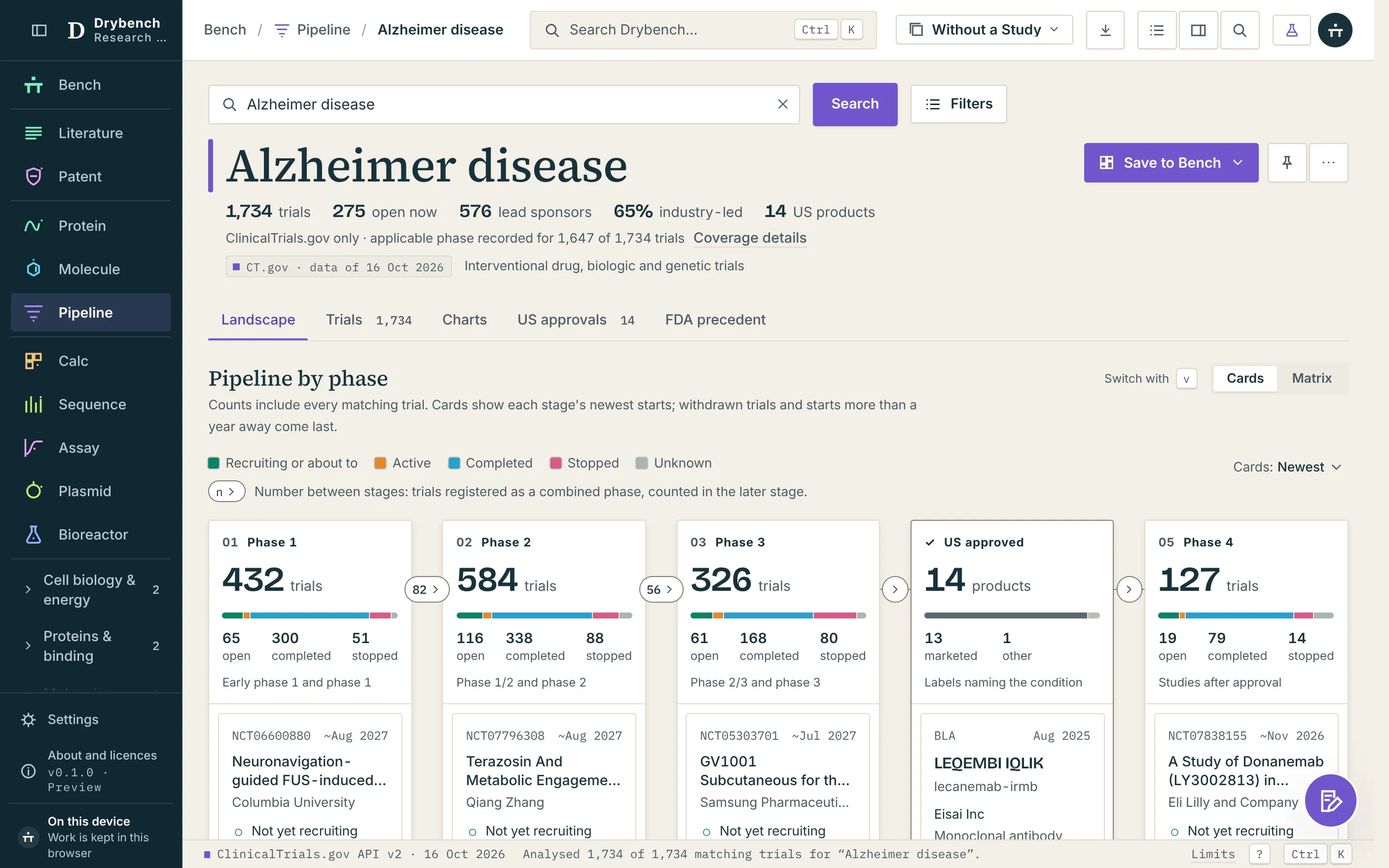
What you can do with it
Live trial data
Type a condition and the app downloads the matching interventional drug, biologic and genetic trials from ClinicalTrials.gov, up to the newest 10,000, and says how many it analysed.
Cards and Matrix
Read the pipeline as Cards, stage by stage from Phase 1 to US approval, or as a Matrix, where every cell of the phase by status matrix lists its trials.
US approvals
Products whose current FDA label names the condition, from openFDA, with sponsor, original approval date (or NDC marketing start where Drugs@FDA has none) and marketing status; labels that mention the condition only to rule it out are flagged.
FDA precedent
For the condition's US products that FDA lists as new molecular entities or new biologics: accelerated or traditional approval, designations and the time from receipt to approval, each cited to the FDA record.
Durations and stop reasons
Median trial duration by phase from completed trials, and the reasons trials stopped, grouped, with an example of the registered wording for each group.
Sponsors
The twelve lead sponsors with the most trials, and the share of trials that industry leads.
Charts you can read
The Matrix layout and starts timeline, and four charts of modality, durations, sponsors and stop reasons, each with a legend, keyboard navigation and a data table, so each value can be read and checked.
Dated snapshots
The seven example searches can open from snapshots saved on a stated date, which stop showing once they are more than 60 days old.
Start with a worked example
Explore a configured workflow with its starting data and methods ready to inspect.
- Public source data
KRAS G12D Clinical Trials: Selected Registry Landscape
Explore selected KRAS G12D clinical trials in an interactive browser workspace. Inspect cited registry records, phases and sponsors with clear capture limits.
Starting data: Six selected KRAS G12D study records
Explore example - Public source data
HER2 ADC Clinical Trials and Selected TROP2 Comparison
Explore selected HER2 ADC and ADC-sequencing studies in an interactive browser workspace. Review cited trial records, intervention names and capture limits.
Starting data: Selected HER2 ADC and ADC-sequencing studies
Explore example
More examples (1)
See the evidence behind the answer.
Explore the methods and sources behind the tools.
Read the methodsWhere every panel's data comes from
ClinicalTrials.gov API v2
ClinicalTrials.gov API v2ClinicalTrials.gov Terms and Conditions: no charge; attribute the source, keep the data current, show the processing date and state modifications (the data carry copyright outside the US)Live trial records: phase, status, dates, sponsor, enrolment, interventions and stop reasons
Source: ClinicalTrials.gov, U.S. National Library of Medicine, with the ClinicalTrials.gov processing date shown in the tool (or, if that is unavailable, the retrieval time). Modified by this site: records are filtered to interventional drug, biologic and genetic trials, aggregated and labelled with a modality, and trials that test only an imaging agent are set apart from the counts; titles, sponsors and stop reasons are as registered, though long stop reasons are shortened in a chart's data table. In FDA precedent, the trial numbers shown for a product are those named in the Clinical Studies section of its US label, each looked up on ClinicalTrials.gov. Saved snapshots are dated and are not shown once they are more than 60 days old.
openFDA drug label, Drugs@FDA and NDC endpoints
openFDA drug label, Drugs@FDA and NDC endpointsCC0 1.0US-approved products whose label indications mention the condition, with sponsor, original approval date (Drugs@FDA) or NDC marketing start (NDC Directory), and marketing status
Data from openFDA, U.S. Food and Drug Administration. Not endorsed by the FDA.
WHO: Use of stems in the selection of INN for pharmaceutical substances, 2024
WHO: Use of stems in the selection of INN for pharmaceutical substances, 2024CC BY-NC-SA 3.0 IGO (reference only)The naming stems behind the modality classifier, checked stem by stem against Part II B. The short class labels are the tool's own; a few are standard class names (such as tyrosine kinase inhibitor) that the book also uses
WHO. Use of stems in the selection of International Nonproprietary Names (INN) for pharmaceutical substances, 2024. Geneva: World Health Organization; 2024. Licence: CC BY-NC-SA 3.0 IGO.
FDA: Compilation of CDER NME and New Biologic Approvals 1985-2025, with its data dictionary
FDA: Compilation of CDER NME and New Biologic Approvals 1985-2025, with its data dictionaryUS government work, public domain (FDA website policies)FDA precedent: receipt and approval dates, review designation, accelerated approval, breakthrough therapy, fast track and orphan designation at original approval, for CDER new molecular entities and new biologics; a dated snapshot
U.S. Food and Drug Administration, Center for Drug Evaluation and Research. Compilation of CDER NME and New Biologic Approvals 1985-2025. Not endorsed by the FDA.
FDA: CDER Breakthrough Therapy Approvals (current calendar year and cumulative earlier years)
FDA: CDER Breakthrough Therapy Approvals (current calendar year and cumulative earlier years)US government work, public domain (FDA website policies)FDA precedent: breakthrough therapy approvals by application and submission, a cross-check of the compilation and the designation for later approvals; a dated snapshot
U.S. Food and Drug Administration, Center for Drug Evaluation and Research. CDER Breakthrough Therapy Approvals. Not endorsed by the FDA.
openFDA Complete Response Letters (transparency/crl)
openFDA Complete Response Letters (transparency/crl)CC0 1.0FDA precedent: published complete response letters joined to the later approval of the same application, shown by application, company, date and type with a link to FDA's letter; a dated snapshot reduced to those fields, and one live count
Data from openFDA, U.S. Food and Drug Administration. Not endorsed by the FDA.
FDA Oncology Center of Excellence: Project Confirm
FDA Oncology Center of Excellence: Project ConfirmUS government work, public domain (FDA website policies)Saved as a dated snapshot for the precedent table; not shown until its name join to products has a measured precision (CSO, 5 October 2026)
U.S. Food and Drug Administration, Oncology Center of Excellence. Project Confirm. Not endorsed by the FDA.
FDA: Table of Surrogate Endpoints That Were the Basis of Drug Approval or Licensure
FDA: Table of Surrogate Endpoints That Were the Basis of Drug Approval or LicensureUS government work, public domain (FDA website policies)Saved as a dated snapshot for the precedent table; not shown until its match to conditions has a measured precision (CSO, 5 October 2026)
U.S. Food and Drug Administration, CDER and CBER. Table of Surrogate Endpoints That Were the Basis of Drug Approval or Licensure. Not endorsed by the FDA.
Where it runs and what it sends
Public data hosts declared for this app: clinicaltrials.gov and api.fda.gov.
Anything in the address bar before the # (a search, a SMILES, an accession or a step) is sent to this site's host when a page loads or a link is opened; anything after the # is not sent.
Not used, by licence:
- WHO ICTRP web service. Its data are for research use only, may not be stored locally and may not be part of a paid service.
- DrugBank. Its licence is non-commercial.
- Citeline and Evaluate. Subscription databases; never scraped.
- Friends of Cancer Research breakthrough therapy designation CSV. No reuse licence; the designations are taken from FDA's own breakthrough approvals lists.
- CIRS R&D Briefing tables and figures. Copyrighted publication; no table or chart is reproduced.
- FuzeBio and ph3.bio complete response letter databases. Third-party compilations with no licence; openFDA is the source, and ph3.bio's classification of reasons is not used.
- Cortellis Regulatory Intelligence, PharmaPendium, Vivpro, Pink Sheet and Obsidian RI. Subscription services; never scraped.
- Drug label text at scale. Label text is the sponsor's; only NCT numbers are taken from a label, never its sections.
Built for research and education. The tools have not been validated for regulated use. Read the regulatory position
Make your next step a practical one.
Open the app and explore the example.