Interactive tool · Preview
Drybench Protein.
Explore a protein’s sequence, experimental structures and AlphaFold model alongside its annotated features and linked drugs. Read the source for each panel and distinguish experimental evidence from predictions.
Example data: EGFR (P00533). UniProtKB P00533, The UniProt Consortium (CC BY 4.0)
- Free to use
- Runs in your browser
- Transparent methods
Illustration · Explore the real workspace below
See the tools at work.
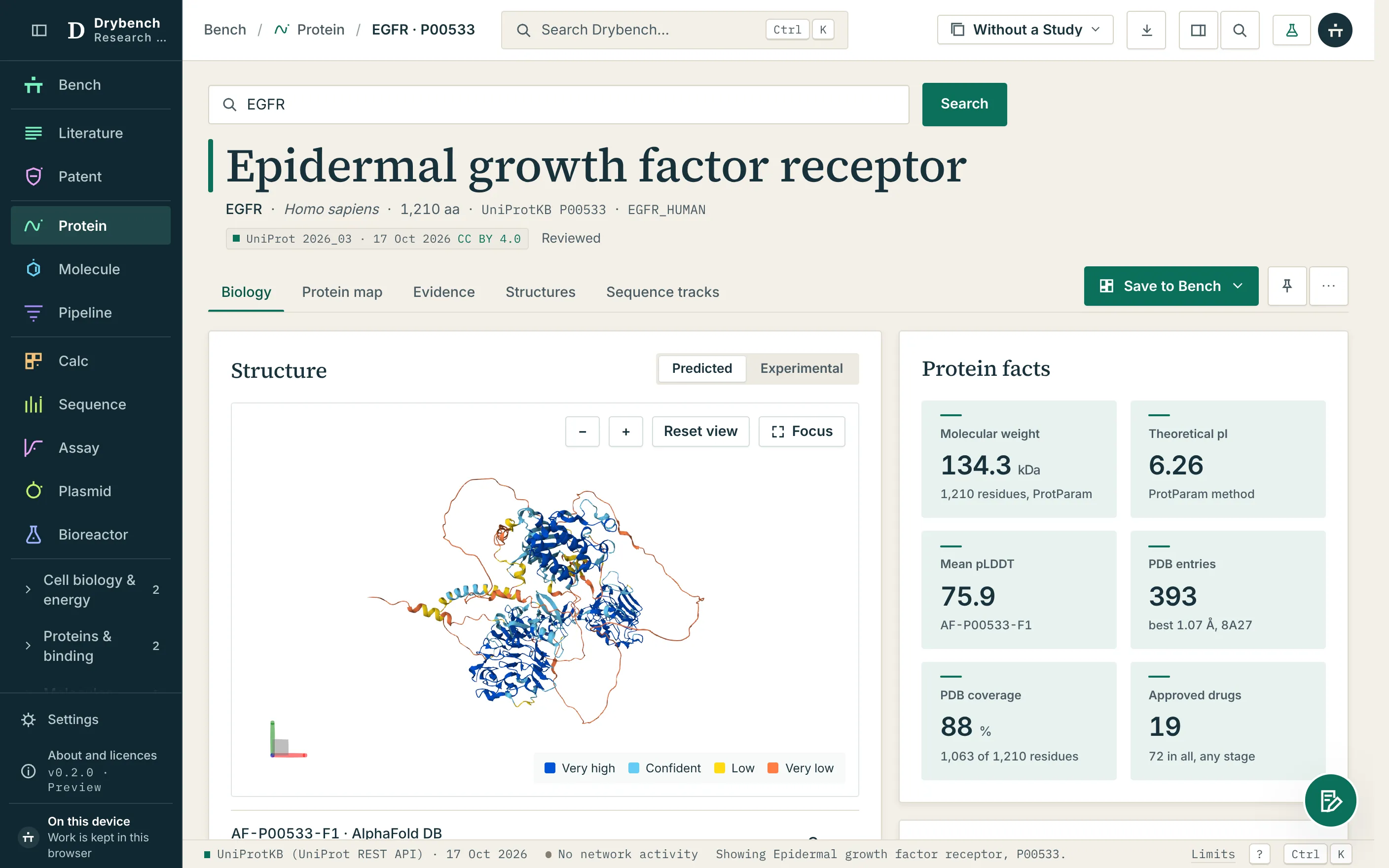
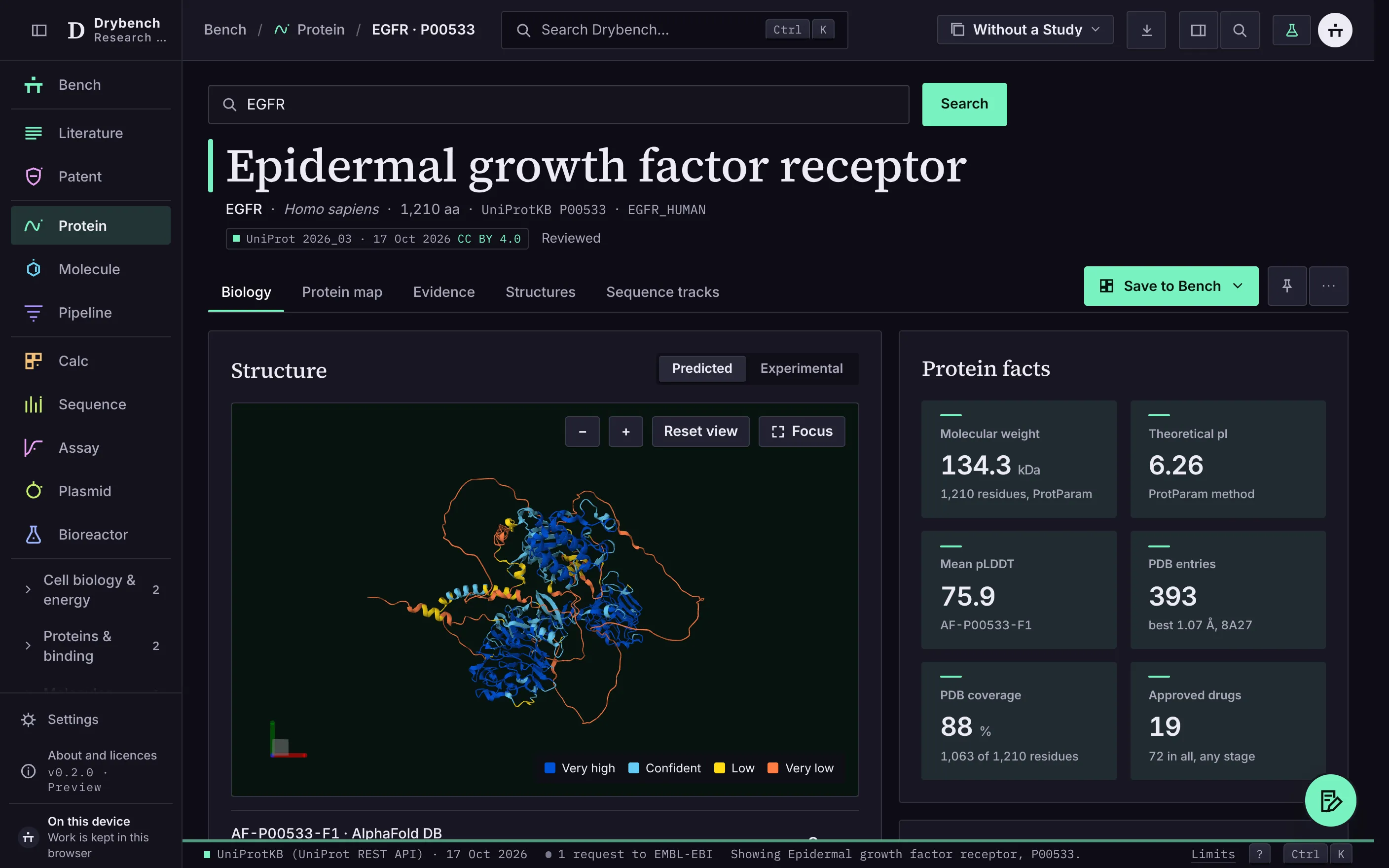
Mol* viewer about 1.5 MB on first use
What you can do with it
Experimental vs predicted
The default PDB entry, chosen by how much of the protein it resolves and at what resolution, beside the AlphaFold DB model; a picked residue follows each source's available correspondence.
Confidence (pLDDT)
Source-model pLDDT colours stay on the model, while the UniProt track and range means use only unique exact residue matches, with missing scores omitted and contributing counts shown.
Sequence tracks
Domains, sites, modifications, topology, structural coverage across every entry, confidence and variants on one zoomable ruler that works from the keyboard.
Drugs and targets
Every drug and clinical candidate whose curated mechanism names the target, from Open Targets, with its stage, withdrawals and indications.
Variants and AlphaMissense
UniProt's curated variants at once, the EBI Proteins API's full list on request with its size shown first, and AlphaMissense scores as an optional track.
Residue-level mapping
Experimental selections use the loaded file’s residue-level SIFTS record checked against current UniProt, showing exact observed residues and qualified annotated substitutions while keeping withheld or unmapped positions explicit.
Links across the suite
A drug name opens in the molecule app and an indication opens as a trial landscape in the pipeline app.
Sources and exports
Each panel names its source and, where the provider reports one, its release or data version, and the exports (PDB entries, drugs and annotations as CSV, the sequence as FASTA, the map, tracks and 3D views as figures) carry their sources, licences and retrieval times inside the file.
Start with a worked example
Explore a configured workflow with its starting data and methods ready to inspect.
- Reference inputs
EGFR UniProt Sequence and PDB Structure Inspection Tool
Explore EGFR sequence and structure in an interactive browser workspace. Inspect UniProt residue numbering, PDB coverage and the limits of variant annotation.
Starting data: Human EGFR P00533 with the ectodomain structure 4UV7
Explore example
See the evidence behind the answer.
Explore the methods and sources behind the tools.
Read the methodsWhere every panel's data comes from
UniProtKB (UniProt REST API)
UniProtKB (UniProt REST API)CC BY 4.0Search, names, function and location text, sequence features and curated natural variants; the release is shown with the text
The UniProt Consortium. UniProt: the Universal Protein Knowledgebase in 2025. Nucleic Acids Res 2025;53:D609-D617.
PDBe API, UniPDB and SIFTS mappings
PDBe API, UniPDB and SIFTS mappingsCC0 1.0 (PDB data); EMBL-EBI termsPDB entries and chains mapped to the protein, residues each entry resolves, residue numbering, structure files
Each PDB entry links to its PDBe page, which credits the depositors.
RCSB PDB Data API and model files
RCSB PDB Data API and model filesCC0 1.0Atom counts for very large entries; a second host for structure files
AlphaFold DB
AlphaFold DBCC BY 4.0Predicted models and per-residue pLDDT
AlphaFold Data Copyright (2022) DeepMind Technologies Limited. Jumper et al., Nature 2021 (PMID 34265844); Bertoni et al., Nucleic Acids Research 2026 (PMID 41273079), the paper AlphaFold DB asks users to cite. Models from other providers carry their own credit line on the page, for example Viro3D (Litvin et al., Mol Syst Biol 2025, PMID 40958060).
AlphaMissense (via AlphaFold DB)
AlphaMissense (via AlphaFold DB)CC BY 4.0Optional track: mean predicted pathogenicity per residue
AlphaMissense Copyright (2023) DeepMind Technologies Limited. Cheng et al., Science 2023 (PMID 37733863).
EBI Proteins API, variation
EBI Proteins API, variationEMBL-EBI terms; source terms applyOptional: further variants, with clinical classifications where they exist (UniProt, ClinVar, Ensembl, population studies)
COSMIC-only records are excluded because COSMIC requires a commercial licence for public-facing websites. NCBI itself places no restrictions on ClinVar data (individual submitters may hold rights in their submissions).
Open Targets Platform
Open Targets PlatformCC0 1.0Drugs and clinical candidates for the target, mechanisms, stages, indications and withdrawal warnings
Buniello et al., Nucleic Acids Research 2025 (PMID 39657122). The data version is shown with the list. Drug identifiers and mechanisms originate from ChEMBL (CC BY-SA 3.0); Open Targets states that its sources have agreed to use of their data without restriction by Open Targets users.
Mol* 5.11.0
Mol* 5.11.0MIT3D viewers, loaded from the site on demand
Sehnal D et al. Mol* Viewer: modern web app for 3D visualization and analysis of large biomolecular structures. Nucleic Acids Res 2021;49:W431-W437.
Where it runs and what it sends
Public data hosts declared for this app: rest.uniprot.org, www.ebi.ac.uk, data.rcsb.org, models.rcsb.org, alphafold.ebi.ac.uk and api.platform.opentargets.org.
Anything in the address bar before the # (a search, a SMILES, an accession or a step) is sent to this site's host when a page loads or a link is opened; anything after the # is not sent.
Not used, by licence:
- COSMIC. Its use in a commercial product or a public website needs a commercial licence, so COSMIC-only variant records are left out.
- DrugBank. Its licence is non-commercial; drug data comes from Open Targets instead.
- KEGG. Non-academic use needs a commercial licence.
- OMIM. Commercial use needs a licence.
- AlphaFold 3 outputs. Their terms allow non-commercial use only; predicted models come from AlphaFold DB (CC BY 4.0).
Built for research and education. The tools have not been validated for regulated use. Read the regulatory position
Make your next step a practical one.
Open the app and explore the example.