Interactive tool · Preview
Drybench Calc.
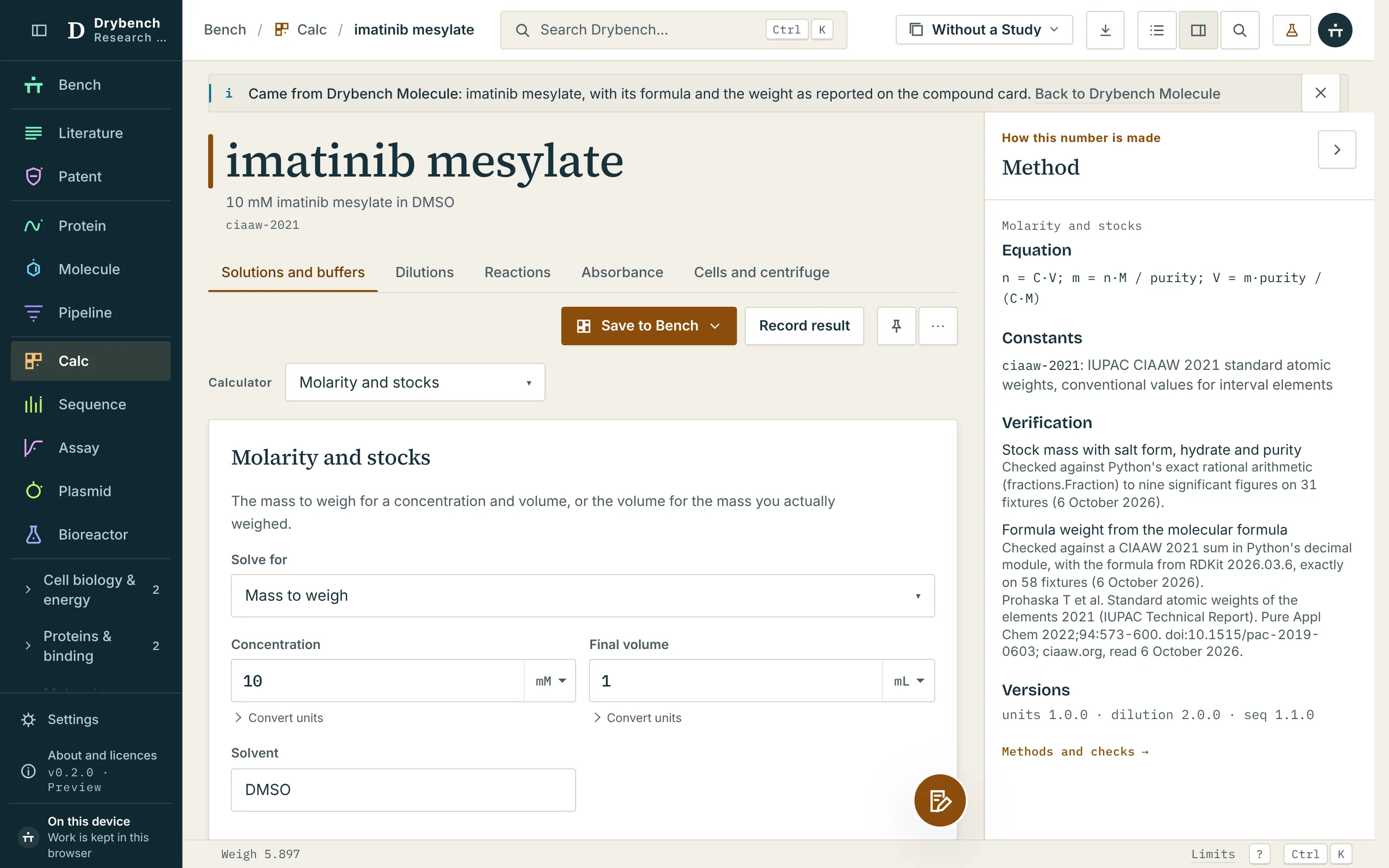
Plan stocks and dilutions from the quantities you have. Calculate the mass to weigh or volume to add using the formula weight of the exact form you enter.
Example data: Imatinib mesylate stock. PubChem CID 123596 (imatinib mesylate), NCBI; formula weights by IUPAC CIAAW 2021
- Free to use
- Runs in your browser
- Transparent methods
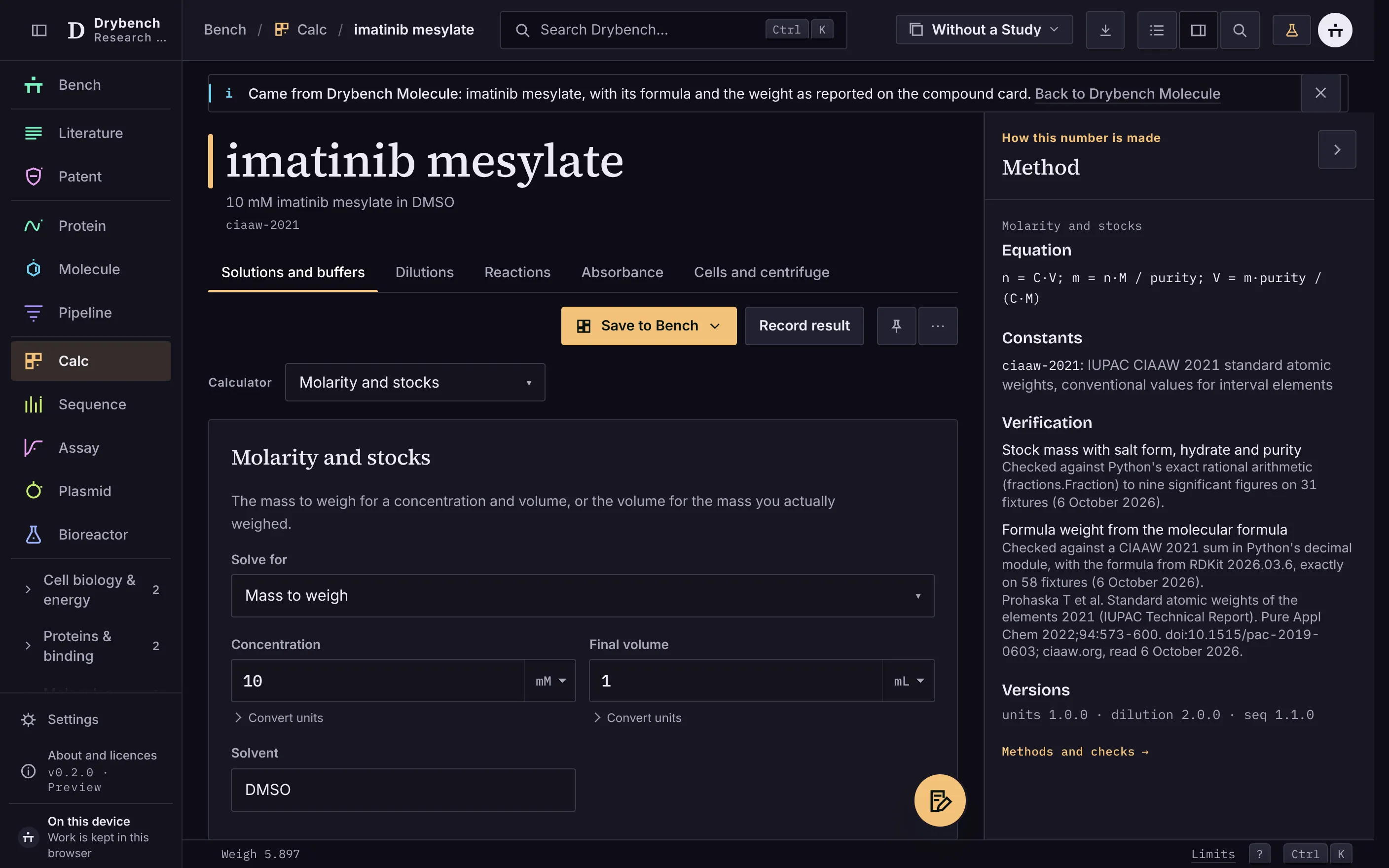
Illustration · Explore the real workspace below
See the tools at work.
What you can do with it
Molarity and C1V1
The mass for a concentration and volume, the concentration a weighed mass gives, and C1V1 with the diluent to add, every field carrying its unit.
Weigh what you weighed
Enter the 11.37 mg actually on the balance and get the volume of solvent for exactly the concentration you wanted.
Salt, hydrate and purity
A compound from the molecule app arrives with the formula of the whole input and of its parent, so a mesylate is weighed on its own formula weight and the shortfall of weighing the parent is stated.
Serial-dilution planner
A top concentration, a fold, a point count and replicate wells give the volume per tube, the transfer, the stock to draw, a pipetting flag below 2 µL and the DMSO at every point, exported as the table the assay analyser will read.
A280 with the sequence
Paste or receive a protein sequence and the sheet computes ε280 by Pace 1995 in both cysteine conventions and the molecular weight, then the concentration from your reading, with the tag on or off.
Buffer pKa at temperature
The pKa of 34 buffer reactions at your working temperature from Goldberg et al. 2002, with the Tris shift of about 0.028 per degree shown as the linear approximation it is.
Recipe table and labels
A multi-component recipe for a final volume, printed as a sheet or as a stock label whose QR code reopens the calculation.
Checked, cited and shared
Every constant is cited with its table id, every number that depends on a constant or a model carries its method, and the fixtures each module is checked against are published with their hashes.
Start with a worked example
Explore a configured workflow with its starting data and methods ready to inspect.
- Synthetic example
Serial Dilution Calculator for 96-Well Plate Transfers
Plan interactive serial dilution transfers in your browser, pre-loaded with a ten-point reference series. Inspect replicate volumes, surplus and DMSO fractions.
Starting data: Ten-point threefold series from a 10 mM stock
Explore example - Synthetic example
DMSO Stock Reconstitution and Molarity Volume Calculator
Calculate an interactive stock volume in your browser, pre-loaded with imatinib reference inputs. Check formula weight, weighed mass, purity and molarity units.
Starting data: Imatinib free-base stock arithmetic
Explore example - Reference inputs
qPCR Master Mix Calculator with Overage and Dead Volume
Plan an interactive qPCR master mix in your browser, pre-loaded with reference reaction volumes. Separate sample additions, percentage overage and dead volume.
Starting data: Sixteen-reaction reference with 10% overage and 25 µL dead volume
Explore example - Reference inputs
Gibson Vector Insert Molar Ratio and DNA Amount Tool
Inspect interactive DNA amounts in your browser, pre-loaded with a pUC19 reference. Calculate a single-insert molar ratio and review assembly planning limits.
Starting data: pUC19 vector with a 720 bp illustrative insert
Explore example
More examples (11)
- Cell Seeding Density Calculator for Multiwell Plates
- Protein A280 Concentration by Beer Lambert Calculation
- Erlotinib HCl Salt vs Free Base DMSO Stock Molarity Tool
- PCR Reaction Master Mix Planner for 2x Polymerase Mixes
- Tris, HEPES and Phosphate Buffer pKa Temperature Shift Tool
- Centrifuge RCF (× g) to RPM Rotor Speed Converter Tool
- Antibody Working Dilution Calculator: µg/mL and 1:n Titer
- OD600 Bacterial Cell Density and CFU/mL Calibrator Tool
- Percent Solution Calculator: % w/v, % w/w and % v/v Tool
- DNA and RNA A260 Concentration and Yield Calculator
- Two-Step Intermediate Dilution Planner for Small Volumes
See the evidence behind the answer.
Explore the methods and sources behind the tools.
Read the methodsWhere every panel's data comes from
IUPAC CIAAW standard atomic weights 2021
IUPAC CIAAW standard atomic weights 2021Values cited from the published tableFormula weights: the conventional value for each interval element (H, C, N, O, S and Cl among them) and the abridged value for the rest, as exact decimals held in one table under src/lib.
Prohaska T, Irrgeher J, Benefield J, et al. Standard atomic weights of the elements 2021 (IUPAC Technical Report). Pure Appl Chem 2022;94:573-600. ciaaw.org read 6 October 2026.
Goldberg, Kishore and Lennen 2002, buffer ionisation thermodynamics
Goldberg, Kishore and Lennen 2002, buffer ionisation thermodynamicsValues cited from the published tablepK, ΔrH° and ΔrCp° at 298.15 K and zero ionic strength for 34 buffer reactions, and the paper's equation 12 for pK at another temperature.
Goldberg RN, Kishore N, Lennen RM. Thermodynamic quantities for the ionization reactions of buffers. J Phys Chem Ref Data 2002;31:231-370. Section 8 read 6 October 2026.
Pace et al. 1995, molar absorption coefficients
Pace et al. 1995, molar absorption coefficientsMethod (cited)ε280 = 5,500 per Trp + 1,490 per Tyr + 125 per cystine, in both conventions (all cysteines paired, all reduced).
Pace CN, Vajdos F, Fee L, Grimsley G, Gray T. How to measure and predict the molar absorption coefficient of a protein. Protein Sci 1995;4:2411-2423.
A260 conversion conventions (Thermo Fisher; Cavaluzzi and Borer 2004)
A260 conversion conventions (Thermo Fisher; Cavaluzzi and Borer 2004)Values cited from the published pagesThe A260 rules of thumb, in µg/mL per absorbance unit at 1 cm: 50 for dsDNA and 40 for RNA as Thermo Fisher prints them, and 33 for ssDNA, the convention NanoDrop instruments apply. Cavaluzzi and Borer measured 38 for non-repetitive ssDNA. These are conventions, not measurements, and not for oligonucleotides, which need a sequence-specific ε260.
Thermo Fisher NanoDrop One FAQ; Thermo Fisher technical note MCS-TN1315-EN 2/25, Accurate Oligonucleotide Quantification with NanoDrop Spectrophotometers; Thermo Fisher, DNA and RNA Molecular Weights and Conversions; IDT, ‘Oligo quantification: Getting it right’ (modified 22 August 2025); Cavaluzzi MJ, Borer PN. Revised UV extinction coefficients for nucleoside-5′-monophosphates and unpaired DNA and RNA. Nucleic Acids Res 2004;32(1):e13, doi:10.1093/nar/gnh015 (Method 1: 33 µg per A260 unit). Read 17 October 2026.
ExPASy ProtParam residue masses and pK values
ExPASy ProtParam residue masses and pK valuesValues cited from the documentationThe average residue masses and the Bjellqvist pK values the protein app has always used, kept as the default so both apps give one number; a CIAAW-derived residue table sits behind a second id.
Gasteiger E, Hoogland C, Gattiker A, et al. Protein identification and analysis tools on the ExPASy server. In: The Proteomics Protocols Handbook. Humana Press; 2005:571-607. Documentation read 5 October 2026.
PubChem (NCBI)
PubChem (NCBI)No NCBI restrictions; depositor terms may applyThe compound identifiers (CID and standard InChIKey) and formulas of the 75 reagents in the shipped table, read once when the table was curated and checked against the hand-typed formulas; nothing is fetched while you work.
Kim S, Chen J, Cheng T, et al. PubChem 2025 update. Nucleic Acids Res 2025;53:D1516-D1525. Records read 6 October 2026.
uqr 0.1.3
uqr 0.1.3MITThe QR code on a stock label, drawn in your browser as inline SVG; it loads only with the label dialog.
Copyright (c) 2023 Anthony Fu.
NIH Global Substance Registration System
NIH Global Substance Registration SystemCited public substance identity factsThe complete chemical definition explicitly linked to retatrutide's UNII record, including modified residues and stereochemistry. Shipped locally; the source identifiers and retrieval date accompany the structure.
NCATS / FDA Global Substance Registration System, UNII NOP2Y096GV, alternate chemical definition 210e2d2c-6b8e-4b0d-b432-20057541f324, version 1, retrieved 8 October 2026.
Where it runs and what it sends
Public data hosts declared for this app: pubchem.ncbi.nlm.nih.gov.
Anything in the address bar before the # (a search, a SMILES, an accession or a step) is sent to this site's host when a page loads or a link is opened; anything after the # is not sent.
Not used, by licence:
- CAS Registry Numbers. CAS numbers are proprietary identifiers, so the reagent table carries PubChem CIDs and InChIKeys instead.
- phbuffers.org database. Its licence is not stated, so the buffer pKa calculator links to the site rather than using its data.
- GPL primer-design code. Its licence would extend to the app's own code once shipped in the browser; melting temperatures belong to the sequence app.
- Biopython residue tables. Not copied: the values come from the cited papers, and Biopython serves only as an offline test oracle.
- Vendor formula-weight tables. Vendor labels use their own atomic weights and lot data, so the table is computed from formulas with the IUPAC 2021 values and the label's weight can be typed over it.
- Cavaluzzi and Borer 2004 nearest-neighbour ε260. The parameter table could not be checked against the paper before release, so oligonucleotide ε260 is not computed in this version.
Built for research and education. The tools have not been validated for regulated use. Read the regulatory position
Make your next step a practical one.
Open the app and explore the example.