RNA Splicing
Join exons, remove an intron and compare the messages made from one gene.
Loading the experiment…
Quick reference
The first transcript
A eukaryotic pre-mRNA can contain both exons and introns. Splicing removes introns and joins the retained exons. Exons can contain untranslated regions as well as protein-coding sequence.
An RNA machine
The spliceosome contains proteins and small nuclear RNAs. In the usual spliceosomal reaction, the intron forms a branched lariat intermediate before the flanking exons are joined.
Alternative outcomes
Regulated use of splice sites can produce different transcripts from a gene. Exon skipping may preserve or change a coding frame, depending on the boundaries. A real cell can produce a mixture of isoforms; the choices here are fixed teaching examples.
Check your understanding Optional
Does skipping an exon always cause a frameshift?
At the bench
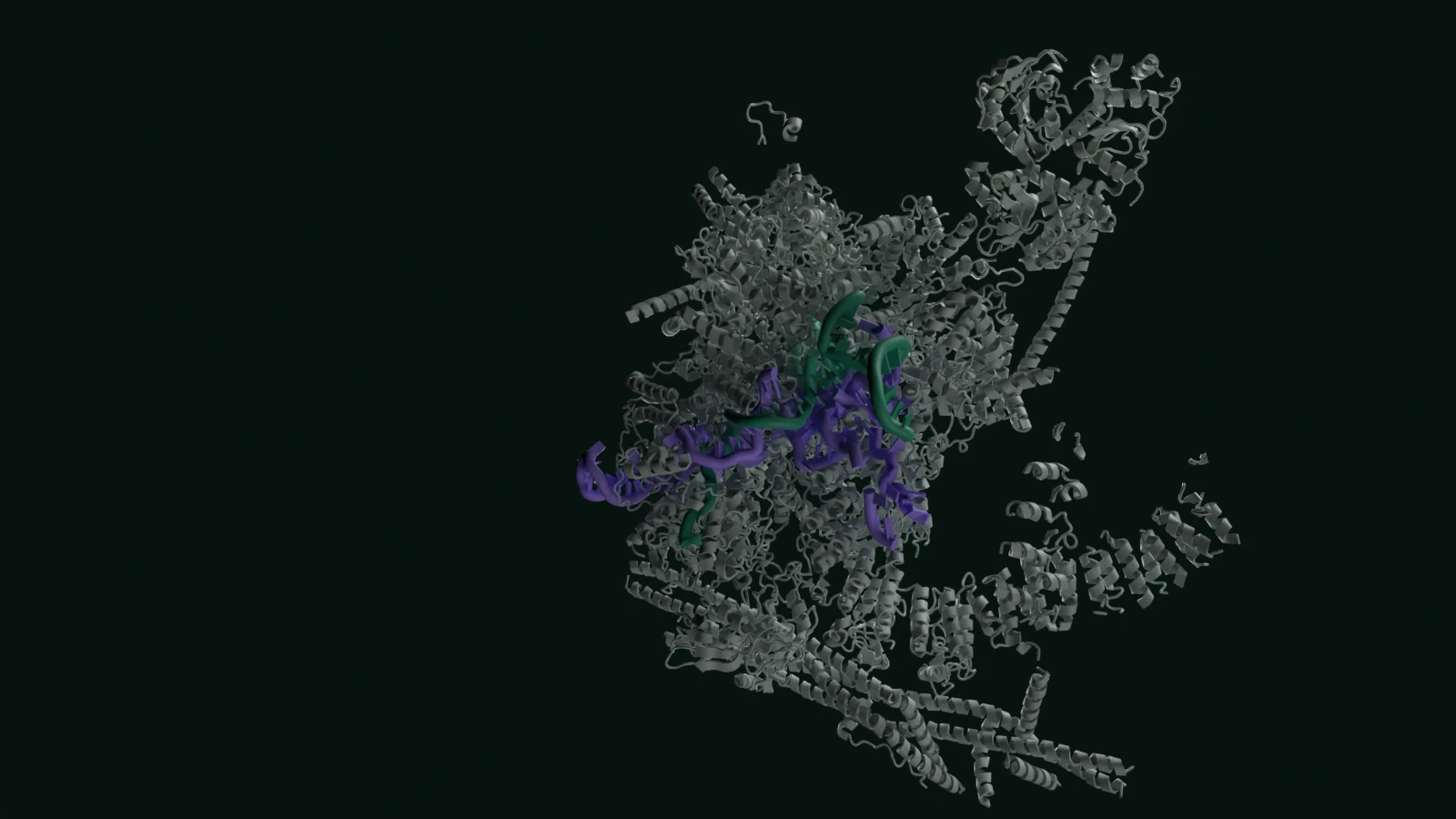
Inspect the experimental spliceosome structure used in the Cell tour.
Open CellSources and model notes
Structure-based views of resolved experimental coordinates. Cutaways, category colours, camera choices and guided highlights are authored for teaching. Coordinates remain fixed; highlights are not experimental trajectories or simulation outputs.
Human post-catalytic complex with an experimental RNA substrate.
Researcher explanation of different transcript outcomes, including SMN2.