DNA Replication
Follow a replication fork and discover why copying two strands takes different routes.
Loading the experiment…
Quick reference
Two templates, opposite directions
The strands of a DNA duplex run antiparallel. Each parental strand can serve as a template for a complementary new strand, leaving each daughter duplex with one parental and one new strand.
One direction for synthesis
DNA polymerases extend a primer at its 3′ end, so new DNA grows 5′ to 3′. At a moving fork, one new strand can be extended continuously while the other is made as successive Okazaki fragments.
Finish the backbone
After primers are removed and replaced with DNA, ligase seals the remaining nicks in the sugar-phosphate backbone. Without that joining step, adjacent pieces can be correctly paired to the template but remain unsealed.
Check your understanding Optional
After primer removal and replacement, what is ligase needed for?
At the bench
Practise reverse complements and strand direction when reading templates and primers.
Open SequenceSources and model notes
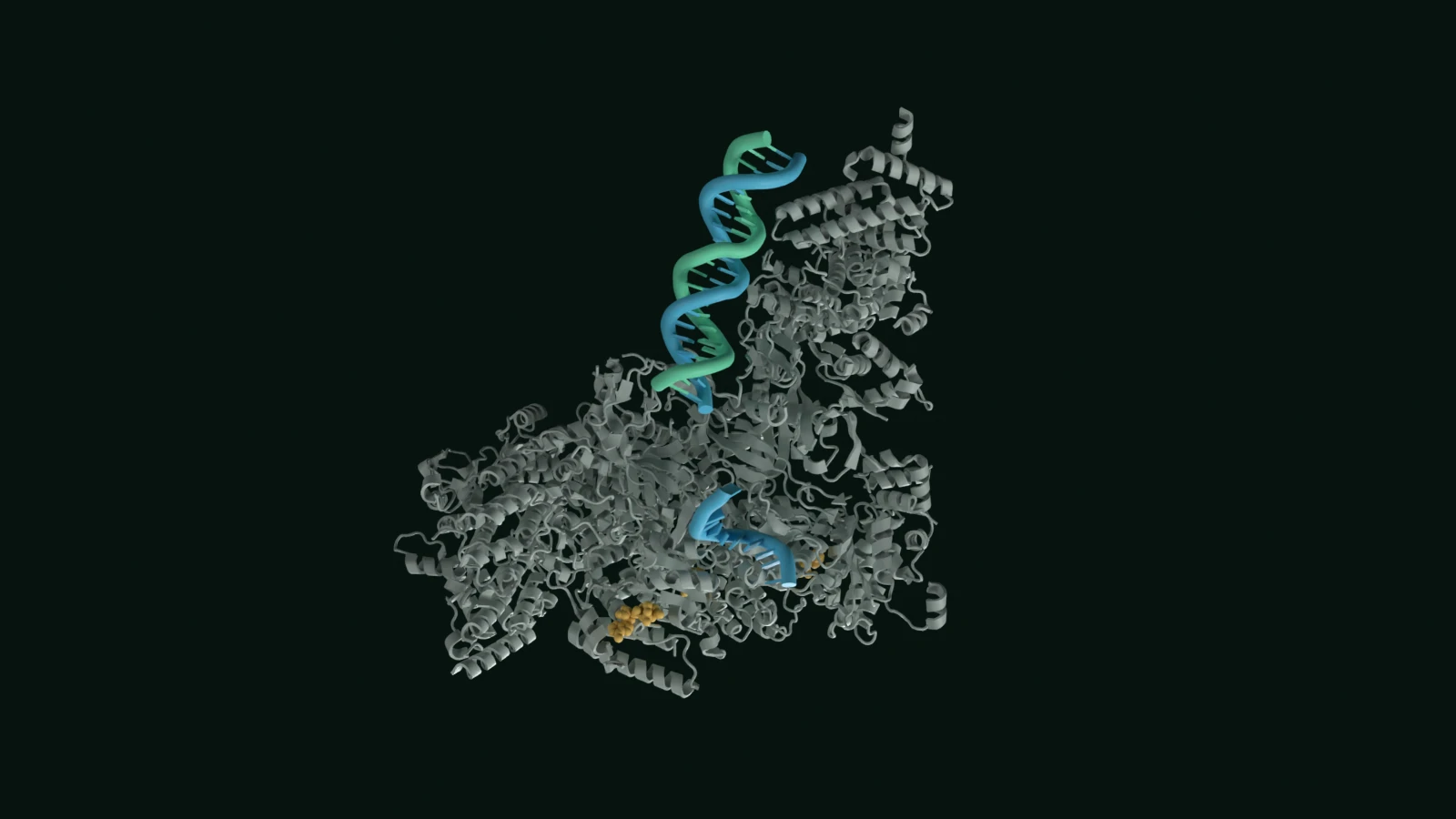
Structure-based views of resolved experimental coordinates. Cutaways, category colours, camera choices and guided highlights are authored for teaching. Coordinates remain fixed; highlights are not experimental trajectories or simulation outputs.
Experimental structure of a core human replication assembly; the model diagram is schematic.
Background on continuous and discontinuous copying.