ATP Synthase
Connect a proton gradient, a rotating molecular motor and ATP production.
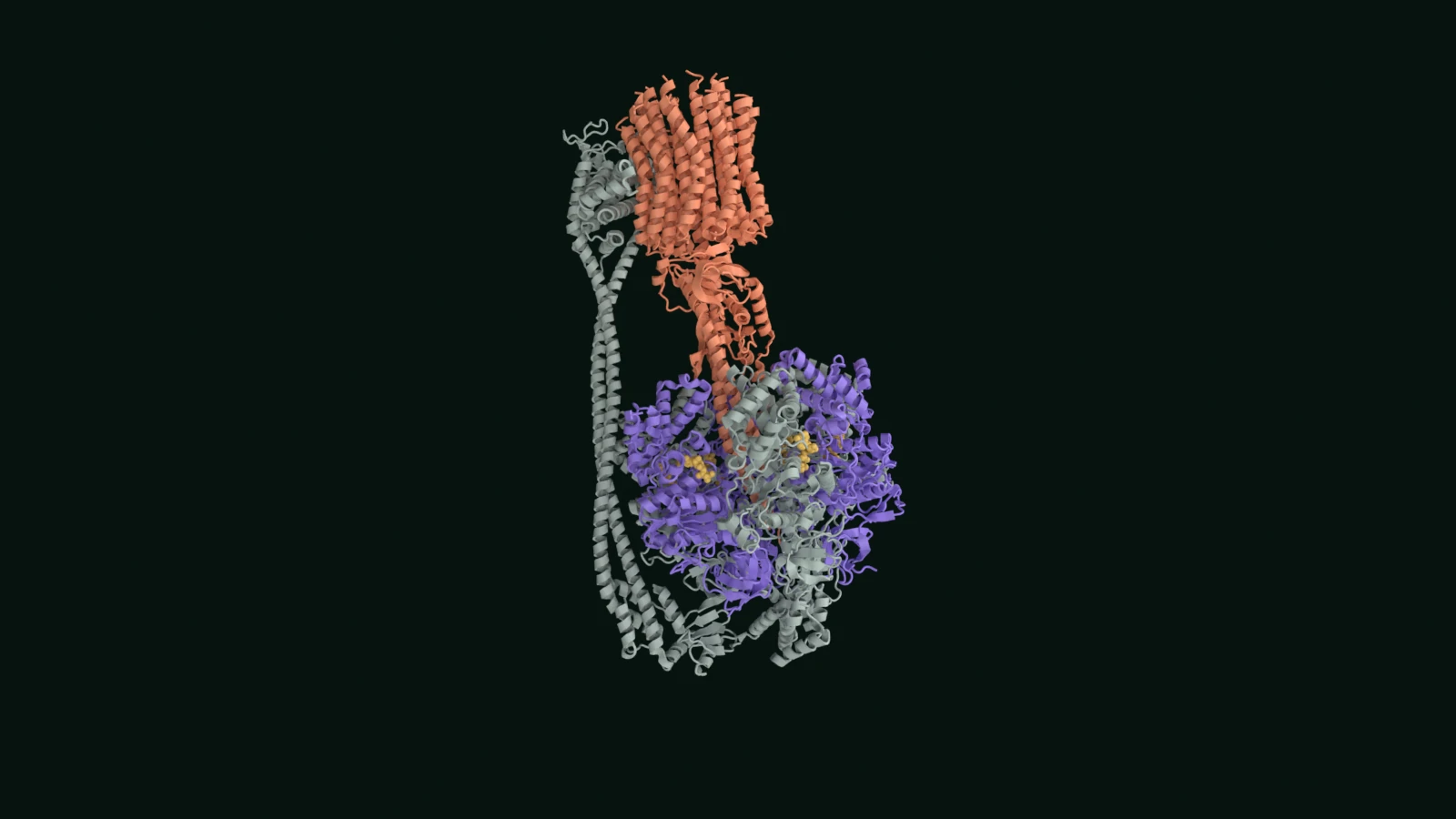
Loading the experiment…
Quick reference
Stored energy across a membrane
A proton electrochemical gradient has both a concentration component and an electrical component. It can drive protons through the membrane portion of ATP synthase.
Rotation changes binding sites
The rotor couples proton movement to changes in the catalytic head. During synthesis, binding sites bind ADP and phosphate, form ATP and release it. The model steps separate these coupled events for clarity.
A leak bypasses the motor
Proton flow through other routes can dissipate the gradient without driving ATP synthesis. The effect depends on the system maintaining the gradient. This model uses qualitative states, not measured synthesis rates, and leaves reverse operation out of scope.
Check your understanding Optional
A proton leak increases while the system supplies the same input. Why may ATP production decrease?
At the bench
Explore protein structure and function after seeing how a molecular assembly couples movement to chemistry.
Open ProteinSources and model notes
Structure-based views of resolved experimental coordinates. Cutaways, category colours, camera choices and guided highlights are authored for teaching. Coordinates remain fixed; highlights are not experimental trajectories or simulation outputs.
Structural states and coupling between the two motors.
Experimental bacterial assembly; the model is an authored schematic.